
How to Reduce Anxiety and Stress Instantly With Acupressure

I first became interested in acupressure after I was diagnosed with cancer at age 19.
My life turned upside down in the span of a week.
One morning I went for a blood test to see why my period hadn’t come for months and that very night, I was admitted to the hospital for what the doctors suspected to be Leukemia. A few days later, I received an official diagnosis and started chemotherapy right away.
Needless to say, it was a highly stressful time in my life. It was during that time when I had my first panic attack. And the anxiety quickly spiraled out of control from there. It wasn’t long before I started having insomnia, extreme restlessness, chest pain and tightness on a daily basis.
Wanting to take control of my own physical and emotional health, I dove deep into acupressure after learning about it through a holistic health TV program. After trying it on myself, I quickly fell in love with this simple and effective self-healing method.
Acupressure not only helped me regain my physical health after a long battle with Leukemia, it also helped me get over the emotional strains caused by the disease.
I’m passionate about learning this wonderful practice and eager to share everything I know about it. I hope by spreading my knowledge of acupressure, someone else might be able to benefit from it just as I did (and still do).
Today, I’m going to show you my top 5 acupressure points for anxiety relief, and how you can apply acupressure massage on yourself to calm down in a flash.
But first, let me explain what, exactly, is acupressure, and just how effective it is for alleviating anxiety.
This post contains affiliate links, meaning, at no additional cost to you, I will earn a commission if you click through and make a purchase. As an Amazon Associate, I earn from qualifying purchases. Read the full (warning: it’s boring) disclosure here.
Contents
What is Acupressure?
Acupressure,similar to acupuncture, is a holistic healing practice with roots in Traditional Chinese Medicine (TCM).
The core philosophy behind both acupressure and acupuncture is that we can create powerful health effects by stimulating certain points along invisible channels—known as meridians—running throughout our body.
Practitioners of TCM believe if there are stagnation or blockages along any of these meridians in our body, we could experience discomfort, pain, and even illness.
This is where acupressure and acupuncture come in handy. Both practices help remove these blockages. The only difference between them is that acupuncture achieves its effects with the use of specialized needles. Needless to say, it’s not something beginners like us can (or want to) DIY at home.
Acupressure, on the other hand, is nothing more than a gentle massage. making it highly accessible to even the most beginner of beginners.
Is Acupressure Really Effective for Anxiety Relief?
Admittedly, there’s not a whole lot of research out there with a definitive conclusion on the effectiveness of acupressure for anxiety relief, but the studies done so far have produced promising results.
For example, one double-blind, randomized clinical trial showed that acupressure significantly reduced anxiety in cancer patients. Another more recent study showed that acupressure helpedimprove symptoms of anxiety in women undergoing fertility treatments.
Like most other holistic healing practices out there, acupressure lacks hard scientific evidence to prove its effectiveness, at least for now anyway. But that doesn’t mean it doesn’t have any value.
For me, I’ve had nothing but positive results using acupressure, and that’s good enough in my book.
I have no problem trying alternative therapies that haven’t gone through a hundred double-blind studies and been given the “seal of approval” by conventional science.
There are a lot of things in this world science can’t explain, and I’m okay with that. I’m not from the camp of “if it’s not proven by science, it’s not real”. And I’m certainly not going to bother analyzing whether the great results I’ve experienced are a mere placebo effect or not—all it matters is I feel better.
Does that mean I think acupressure is the magic bullet that cures all anxiety? Absolutely not! I believe everyone’s symptoms and response to treatments are unique. What works astoundingly well for me may fall flat for you.
Hey, it doesn’t hurt to give it a try, right? But please don’t use acupressure as a substitute for anxiety treatments you’re already taking, or take my recommendations as medical advice. And if your anxiety doesn’t get better, I strongly encourage you to seek professional help.
With that said, let’s get into my top 5 acupressure points for anxiety relief, shall we?
5 Best Acupressure Points for Anxiety Relief

1. Tai-chong (Great Surge)
“Tai-chong”, also called “Great Surge” is one of the best acupressure points for reducing stress and anxiety. It’s also the go-to point for detoxifying the body and cleansing the liver.
Where to find it:
You can find this acupressure point between your big toe and second toe, where the connective tissues are just before the large foot bone.
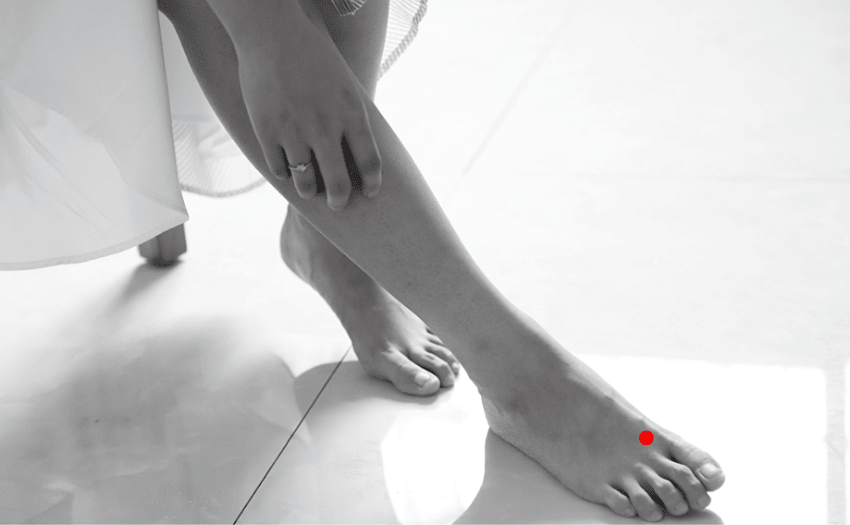
How to massage the “Great Surge” acupressure point:
- Gently massage this area with your thumb in a circular motion for 30 seconds.
- Then with the tip of your thumb, push out from this point away from your body (a little massage oil will help make this step easier). Imagine you’re expelling toxins out of your body when you do this.
- Repeat the above steps for 5 minutes each time.
If you have a lot of pent-up stress, the whole area will feel sore and tender at first, but as you continue to massage this point, the initial discomfort will go away and you’ll feel a noticeable “lightness” in your body.
Learn how you can manage symptoms of anxiety with these 5 amazing acupressure points!
2. Zhi-yang (Reaching Yang)
If you suffer from chest tightness and pain as a result of anxiety, “Zhi-yang”, or “Reaching Yang”, is a point you can’t miss.
Where to find it:
The point is located in the middle of your upper back, in between your shoulder blades. If you have trouble reaching for it with your bare hands, try using a self-massage tool. Or you and your partner can take turns massage this point for each other!

How to massage the “Reaching Yang” acupressure point:
- Gently massage this point in a circular motion with both your forefinger and middle finger whenever you feel there’s tension in your chest.
- Apply pressure for 30 seconds, release, and repeat for 5 minutes each time.
3. Nei-guan (Inner Pass)
“Nei-guan”, or “Inner Pass”, is an important point in Traditional Chinese Medicine. Its main functions include alleviating nausea, opening the chest, and calming the spirit.
Where to find it:
You can find this point in the crevice between the two tendons of your inner arm, approximately two inches below the crease of your wrist.

How to massage the “Inner Pass” acupressure point:
- Use the tip of your thumb to get into the groove where this point lies on your inner arm. Apply pressure to this point and massage in an “up and down” motion.
- Apply pressure for 30 seconds, release, and repeat for 5 minutes each time.
4. Lao-gong (Labour Palace)
Fatigue and restlessness are two usual symptoms that accompany stress. The next acupressure point—“Lao-gong”, or “Labour Palace”—will help ease these symptoms.
Where to find it:
To find this point, first make a fist with your hand. Where the tip of your middle finger touches your palm is where you’ll find “Lao-gong”.

How to massage the “Labour Palace” acupressure point:
- Use the tip of your other thumb to massage this point in a circular motion for 5 minutes each time.
5. Yong-quan (Gushing Spring)
“Yong-quan”, or “Gushing Spring”, is revered by TCM practitioners as an essential point for maintaining health and promoting longevity. It’s also an effective point for managing anxiety.
You can use this point to treat the following stress-related symptoms:
- Insomnia
- Dry mouth
- Headaches
- Palpitations
Where to find it:
You can find this point on the soles of your feet. If you curl your toes, you’ll notice a shallow depression in the middle of your sole, near the first 1/3 section of your foot. This is where “Gushing Spring” lies.

How to massage the “Gushing Spring” acupressure point:
- Apply firm pressure to this point with the tip of your thumb and massage in a circular motion.
- Another way to stimulate this point is to rub this entire area with your palm, up and down, for 5 minutes a day.


And if you’re going to apply acupressure on yourself regularly, I recommend getting this electronic acupressure tool for ergonomic reasons.


Now your turn! Give these acupressure points a try and let me know what you think via the comments below. I’d love to hear your experience using acupressure!

Recommended Articles Related to Health & Wellness:
How to Give Yourself a Relaxing Self Massage at Home
6 Habits to Avoid If You Suffer From Chronic Illness
Coughing and Sneezing? Natural Cold Remedies That Really Work
Take Better Care of Your Lungs With These Simple and Natural Methods
Hello Sabrina,
Many thanks for publishing this. I would like to comment on this quote from your introduction.
“Like most other holistic healing practices out there, acupressure lacks hard scientific evidence to prove its effectiveness, at least for now anyway. But that doesn’t mean it doesn’t have any value.”
I have been receiving acupuncture and acupressure for over 30 years for various health issues. I have never been disappointed by either. My comment has to do with
the idea that there needs to be hard science for proof of its effectiveness. On the contrary, these ancient modalities do not need to be proven by a field that neither acknowledges nor respects the connection of body/mind/spirit, nor understands the
the power of healing beyond that limited field. Integrative, holistic approaches to health and well being are beyond the scope of science. There are no quick ‘fixes’ in this regard, but require a deeper understanding of the power of self healing, knowledge and patience. Never has this been more important than now and what we are all experiencing during these challenging times.
Keep on keeping on Sabrina and thank-you again for this blog.
Breathing in…..breathing out.
Hi Lindsay, I totally agree with everything you said! Acupressure/acupuncture really emphasizes on body/mind/spirit connection, which has been long overlooked by the scientific medical community (but it’s starting to gain more traction now, which I’m excited about). My comment was really to help readers understand that not everything under the sun has received (or needs to receive) a scientific seal of approval, if it works for you, it works period. And acuppressure has worked for me time and time again, so I want to tell people about this wonderful practice you can do at home. My motto is “take your health into your own hands”…literally!
Thanks for reading and taking the time to comment. 🙂
Cheers,
Sabrina
Thank you for taking the time to write this. I’m just discovering the benefits of acupressure myself and found this very beneficial. I have also been using a shakti mat and find this beneficial as well. I wish you all the best in your journey
Hi Kylie, it’s wonderful to hear that you found my article helpful. I’ve always wanted to try a shatki mat myself!
Wish you the best in your health journey as well, and looks like you’re on the right path. 🙂
Cheers,
Sabrina
Thank you for taking the time to write about acupressure and it’s benefits.I will give these a try.I wish you all the best and better health.
Thank you Maria, let me know how you feel after trying acupressure! Like most good things, it will take time. 🙂
Cheers,
Sabrina
I felt it is easy to understand the blog. Thank you so much..
Virendra Mardi
Hello Virendra, I’m glad you think so! It can be hard to explain acupressure to people who have never tried it before, so I’m happy to hear that the information was easy to understand for you.
Wish you an abundance of health.
Sabrina
Great new planning my visit now.
Hi Luan, I’m assuming you mean you’re planning a visit to an acupuncturist? Hope you enjoy the experience, would love to hear what you think!
Cheers,
Sabrina
Nice blog! Very well written in an easy-to-understand manner. I appreciate your sincere efforts you have made in writing this kind of informative blog. Keep sharing!
Thank you Roslia! Acupressure (and Traditional Chinese Medicine in general) has helped me so much in my life that I feel if I don’t share this information with people, I’m doing a disservice! I will definitely keep writing 🙂